
Gatekeeping the Art World
A cautionary tale of aspiration, disappointment and censure

I had a conversation with an old friend and former art dealer recently about a mysteriously discouraging experience I had with another former dealer with whom we are both familiar, and which continues to propagate outward now a whole decade after its point of origination.
Back in 2013, at age fifty-three, I was able to secure representation in a much-admired gallery in San Francisco. I had known this outfit, under several different iterations and owners, since my late twenties and had long hoped that they might take an interest in my work. I might have had a shot at one point in my thirties, when a well-known artist who was involved with the place offered to make a connection for me. Unfortunately, at that time I was showing with a wonderful dealer in the same city — a man I liked very much and who had sold quite a lot of my work — and I couldn’t bring myself to be disloyal to him by making a jump to another gallery. So, that opportunity passed.
The break finally did come about ten years later, after my original dealer had closed up shop and when, once again, a recommendation from that same well-known painter opened the door to an interview at the sought-after gallery and a chance to show its director some original work.
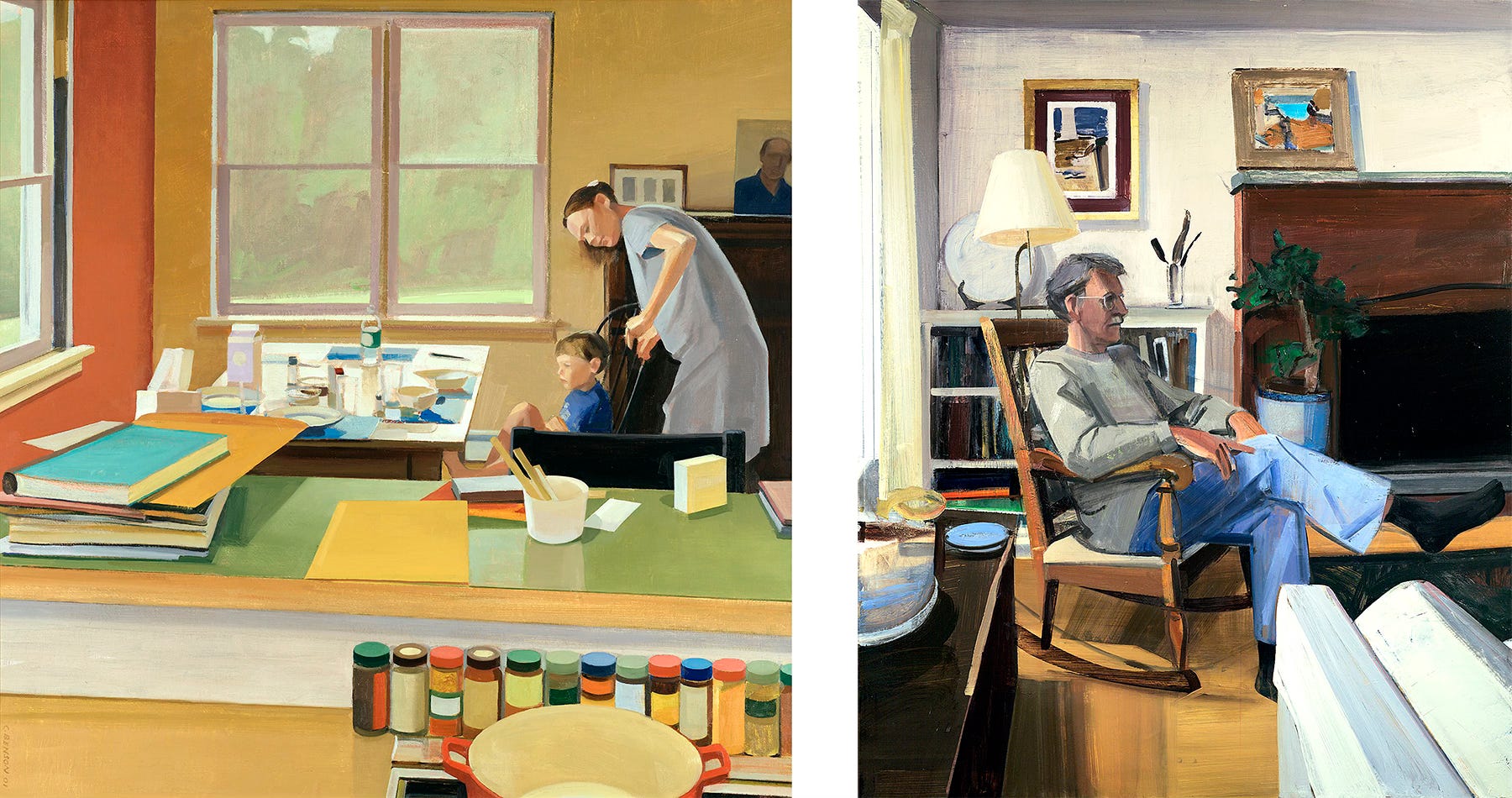
The director was an elegant person with a friendly but cool demeanor. I had brought two paintings to show her, one an example of where I had been, the other an indication of where I was going (or more exactly, where I hoped to go). They were each samples of the best painting I could do at the time, but the latter — a brusquely expressive painterly portrait set in an interior — expressed where my heart really resided at that point, where the former — also a figurative interior, but more starkly realistic — was the apotheosis of a style that I felt had run its course. I had exhausted my pleasure in that work and was eager to move on to something new.
The director however had other ideas. She agreed to give me a try if I would send her more pictures in the older style (she barely even looked at the newer piece). I of course agreed to do as she asked.
Artists, take note! Maybe read that last paragraph again once or twice. What was my mistake? Simply this: I was so flattered to be given a chance to show in that gallery that I swept my feelings under the rug and agreed to revisit a style of work for which I no longer felt any compelling passion.
Forming a relationship with a new dealer is quite a lot like dating. And in the immortal words of Sylvia Miles from the film Crossing Delancey: “Ya look, ya try, ya see. Sometimes it fits. Sometimes it don’t!”
In this case, it never quite fit.
I think there were two reasons for this. On the one hand, I never felt any confidence that the director actually loved my work. She seemed to be taking it in somewhat on sufferance, like the girl at the high school dance who isn’t that into you but who agrees for unknown reasons to take a turn or two across the floor, even as she seems to be looking over your shoulder for a more glamorous partner. And as an old fisherman pal of mine used to say, “I only have one requirement of a woman: she’s got to like me A LOT.” The other problem was that right from the off, I was making pictures I didn’t believe in. I had the skill to make them, but my heart wasn’t there in the effort.
I must say here that we both did our best with the hands we had respectively dealt each-other. She sincerely attempted to interest people in the work I was sending her, taking it to art fairs and even putting on a beautiful solo show for me in her gallery. I, in turn, did my utmost to make the kinds of paintings that I thought she wanted. I even primed the pump by bringing a few sales into the gallery through collectors I had cultivated on my own. But somehow things never quite launched successfully and eventually we politely agreed to part ways.
But somewhere in the mix of this mutually frustrating venture, something else happened which (I think) soured the relationship in a different way, and which perhaps contributed to its ultimate failure. After twenty years of showing and selling my paintings in the San Francisco Bay Area, I began in my early fifties to hope that I might find a museum or two there which would be interested in taking some of that work into their collections. By 2013, when I signed on with the new dealer, many of my earlier pictures from Oakland and Berkeley already resided in private collections in the region, having been sold by my first San Francisco dealer in the 1990s. I thought at this point that it would be smart to validate those collectors’ early support by finding homes for the kinds of work they had purchased in museums near where they lived.
At some point, shortly after joining the gallery, I reached out to the director of the Oakland Museum to see if she might be willing to look at some of my Berkeley paintings. Oakland had a beautiful interior by James Weeks in their collection which had strongly influenced my own interiors from the suburban East Bay and it seemed like an appropriate place to try and place some of that work. I sent an email and quickly received a positive and friendly response which, at least initially, seemed to indicate a sincere openness to this overture. I told the director at the gallery that I had done this, thinking she would see it as a positive effort for both of us, but immediately got a rather frosty response — as if I had committed some unforgivable professional faux pas. Seeming a little taken aback, she let me know that she was close friends with that Oakland director (or perhaps she was a curator), after which we never spoke of it again. I assumed this meant that she would make an approach on my behalf instead and I let it lie.
What happened next is that all communication between myself and the museum ended. I never heard another peep from that person who had at first seemed so open and engaging. Neither was there any follow-up on the subject from the gallery director. What I got instead were the proverbial “Crickets.”
I have no idea what actually happened. I can make assumptions and draw conclusions till all is blue, but they would inevitably all be mere conjecture. It may be that that curator saw a few samples of what I was doing and just wasn’t interested. I do know though that ever since, any effort I’ve made to reach out and connect with anyone remotely associated with that gallery or its now former director have elicited the same stony silence. I would occasionally reach out to somebody in the Bay Area, get a warm initial response and then, after mentioning my former connection to that gallery and its director, the “line” would simply go dead. Things like this happened intermittently over the intervening years but not often enough to make me think too hard about them. If anything, I had begun to feel that I was being paranoid about it all. Then, a few months back, I ran into the old gallery director at my local grocery store in Santa Fe. At that point I hadn’t seen or spoken to her for about ten years. We were both standing in line at the same register and I looked up, recognized her, offered a tentative hello and an “is that you” greeting, when she blanched, hurriedly snatched up her bags, made a brusque excuse about having a dog waiting in the car, and hustled away as quickly as she could.
I honestly don’t know where things went wrong. Something must have occurred which caused offense, or otherwise transgressed in some unacceptable way. Was it because I ventured to contact that curator on my own? Since nobody seems willing to come forward and explain it to me, I’ll just have to carry on imagining what the causes may be, but there is no future in such speculations. One must accept that they are unknowable and walk away. Still, they do point to a larger phenomenon in the world of art and its commercial, cultural and aesthetic marketplace that feels worthy of some examination and consideration. Which brings me back to my opening anecdote about talking with that other dealer friend, and to another recent conversation with a fellow artist.
There is a painter who, for quite some time now, has been engineering his own public image by purchasing glossy color ads in major periodicals and online. This is not somebody who has been either embraced or acknowledged in any hugely visible way by the “art world”. Like many of us, he paints his pictures, finds places to exhibit them and plies his trade as best he can through a combination of personal advocacy and whatever sorts of representation he has been able to secure. But nobody, other than himself, seems ready to showcase his work in a high-profile periodical like the New York Times or the The New Yorker. Having recently seen one of these ads in that very magazine, a sculptor chum back east sent me a fulminating email last weekend in which he expressed some outrage and bafflement at this man’s nerve in splashing his imagery all over the pages of a magazine which, absent (a likely hefty) advertising fee might not otherwise afford him any meaningful ink.
Leaving aside the matter of whether or not the painter in question is any good, or at least good enough to merit the publicity he has found a way to purchase on his own behalf, what does this story, or that of my own curatorial advocacy to the museum in Oakland, tell us about how that determination of “good enough” is actually made? Who gets to make it, and how reliably objective are those supposedly expert determinations in reality? Do they really tell us what is or is not good?
My other dealer friend — the one referenced at the beginning here, and who worked for many years as partner in a venerable family-run gallery in New York — tells me that my experience with the San Francisco gallerist is all about the “gatekeeper” role that dealers, critics and curators have traditionally arrogated to themselves. The presumption upon which they make their bones is one of superior knowledge. They know what is best more than the layperson on the street, more than even the most sophisticated collector to whom they promote an artist’s work, or from whose collections they cull the highest examples to be reviewed in print or housed in our museums. Above all, they presume to know it more than the artists themselves, who are too often treated as presumptuous, delusional or unruly children, better seen than heard.
What is difficult about this dynamic is that all those things that the gatekeepers believe to be true, sometimes are. The very best curators (be they dealers in a gallery or the heads of museum departments) really do know and see a hell of a lot. So do the best critics. And artists are very rarely their own most reliable critics or curators. The reason for this is not that they are less perceptive or knowledgeable about what they do than these other experts. In fact, they know things that those people will never understand because they don’t usually know how to make the things that they are judging. But the curator’s expertise is not only enabled by material, practical, or even art historical knowledge — all of which a truly skilled artist also possesses — but by the fact that the curator is assessing what is actually there, where the artist is always looking (at least in their own work) to the imagined perfection of whatever they had been striving to accomplish; an ideal they have sometimes attained, but have also often missed.
The art world is changing, and along with it, the old kinds of relationships between galleries and artists. It is becoming increasingly financially challenging to run a brick and mortar gallery at all, especially in traditional urban art centers like New York, San Francisco and LA, where rents have skyrocketed and any operation smaller than a Gagosian, David Zwirner or Pace just can’t compete any longer. The art fairs also carry prohibitively expensive fees, if those smaller independent galleries that once formed the backbone of the market can even be accepted into them. The old collector base that supported such places has aged-out, eroded and in some places altogether vanished. At the same time, the internet is enabling a kind of self-representation for artists that was never so readily available or easy to create in the past. And finally, the actual depth and quality of the connoisseurship that once informed the most dedicated dealers, critics and curators is also slipping away. There are layers of artistic quality and nuance that are now completely invisible to a market perpetually hungry for fresh infusions of stylistic or conceptual novelty and celebrity buzz.
I don’t have any easy answers to all these conundrums. I don’t know who should do the gatekeeping, or why, or even if there should be gatekeepers anymore at all. I admire the smartest and most engaged gallerists, critics and museum curators wherever I have had the good fortune to encounter them. I truly do believe that we need them. At best they can be like those magical teachers who change our lives and broaden our vision and understanding. But at worst they are also often bullies, tyrants, egomaniacs and ignoramuses. I therefore can’t fault any artist, myself included, who has spent a lifetime honing their craft and reaching for the best version of themselves, for doing all we can to find homes and secure a legacy for the works we will leave behind when we go. We have every right to do that, even if it feels presumptuous or self-serving to an old guard who came up in a very different world with different rules and taboos.
At the end of the day though — and this has always been true, regardless of which gatekeeping order may have prevailed in the past — the work itself is always the final and most persuasive arbiter of its own worth. If it truly is good, it will stick around as long as there is somebody able to see that quality clearly enough to preserve it.
So the moral here, for my artist friends, is this: by all means seek out and cultivate the most sympathetic and influential advocates that you can find for your own work. But the most important thing any creative person can do is to make good things; things that can move, inspire or inform others in some way that is meaningful enough to them that they are willing to cherish and steward them for those still to come.
Time will take care of the rest.
A fresh, honest discussion about a subject that few painters will talk about- at least, honestly. I appreciate the candor and the worldly wisdom. From my viewpoint, you've had a long and very successful gallery and sales career. Certainly it has its successes and betrayals, but from my own experience and from the many stories I've heard, this is just part of the "business." And your point about the decline of knowledgable dealers, curators and patrons is well taken.
Christopher, It would be interesting, helpful, and maybe even fun to put together an informal forum to consider this subject more deeply and from a variety of perspectives. Linda Durham