
Moksha at the Museum
Bonnard at the Kimbell

As I have often noted here, I grew up with and was much influenced by my Quaker grandmother. I say she was Quaker but truthfully she followed her own spiritual path which, while couched in that community’s ideals, was essentially self-created and not at all religious. She believed in and practiced the Christian ideals of compassion, forgiveness and service, but never described Christ himself as anything more than a relatively awakened human being. She was much more like a Buddhist or Taoist in this respect than a Christian. Who knows how she got there, coming out of the tradition she had. It may be that her husband’s fervent and artisanally-focused Roman Catholicism was constraining enough to spark some more independent, outside-the-box epiphanies about the actual nature of the Big Woo.
Whatever it was that Fisher Benson had, I must have caught it from her, because after regularly attending Quaker meetings all through my twenties I began to drift away towards the eastern philosophies. Like hers, that leg of my journey, which has now unfolded over a thirty-five year span, has been largely self-directed and its conclusions self-made. I’ve had numerous teachers in that time, but rather than engaging in any sort of doctrinal or apostolic practice “according to Hoyle”, those encounters occurred in brief, acute lessons on which I would then go off to read and ruminate for years before returning for a fresh installment. One extraordinary Tibetan gentleman, an elderly lay monk and scholar with a following of students in Santa Fe where I live, treated me once to a single lesson containing the blueprint for a lifetime’s worth of practice. That was almost twenty years ago and I’m still working through what he told us in that session, as I expect that I will be for the foreseeable future, which at sixty-five begins to look like a relatively shortened trajectory.
Whatever my practice may be, it is not religious, nor is it aimed at any higher social or moral purpose than just learning to be as kind as I can be to the people around me (a goal of which I too frequently fall short). The types of “awakening” that interest and inspire me tend therefore to be more experientially than liturgically centered and the locus for them when they do come has often been in my experience of artistic things.
The library of terms invented to describe such moments of heightened consciousness — from the Christian ideas of Grace, Salvation, Revelation etc. to the Buddhists’ Nirvana, Moksha or Satori all seem to revolve around one common experience whose character is understood differently according to the culture native to whomever happens to stumble into it. If that’s so, then my place of awakening is somewhere in the space between my eyes and the objects that a handful of painters, scattered across several centuries of art history, have been able somehow to conure out of nothing more than some scraps of cloth and a scrim of colored grease.
We’ve grown accustomed in our time to think that art has to be about something to be meaningful. I spent years blaming this trend on conceptualism, which in my teens and twenties shifted painting away from the direct, aesthetic thing-in-itselfness of the high Modernism that prevailed in my childhood, into a kind of hyper-intellectualized and philosophically-instructive illustration. On reflection, it wasn’t quite right to see it that way. Much of painting, not just here in the West but all over the world, has always illustrated the ideas and agendas — whether religious, political or more generally cultural — of the societies that produced them. It just happens that a smaller minority of the people who produced those things would periodically veer off into, or else incorporate, a very different kind of making, which then had the potential to evoke a different and more revelatory kind of consciousness in the folks looking at what they had made.
My first and probably most transporting artistic awakening happened at age sixteen when I saw J.M.W. Turner’s Norham Castle, Sunrise for the first time. I saw that thing and quite literally went someplace else, someplace that was bigger and better and more meaningful than the limiting container of my own small and deeply-flawed self. Until a couple of years ago, I’d had many lesser but also transporting experiences since that first one, but few that quite measured up to it, save for a retrospective of Pierre Bonnard’s paintings put on by MoMA in New York in 1998. What both those experiences had in common was that the works made by each of those painters somehow used all the conjoined refinement and originality of their respective approaches to handling their material as a passageway to a vision one sensed must have been as surprisingly transporting to them as makers as it was to me when I encountered what they had made. This is quite a challenging thing to talk about because it isn’t about talking at all. It is about seeing, and then feeling something for which words are ultimately inadequate.
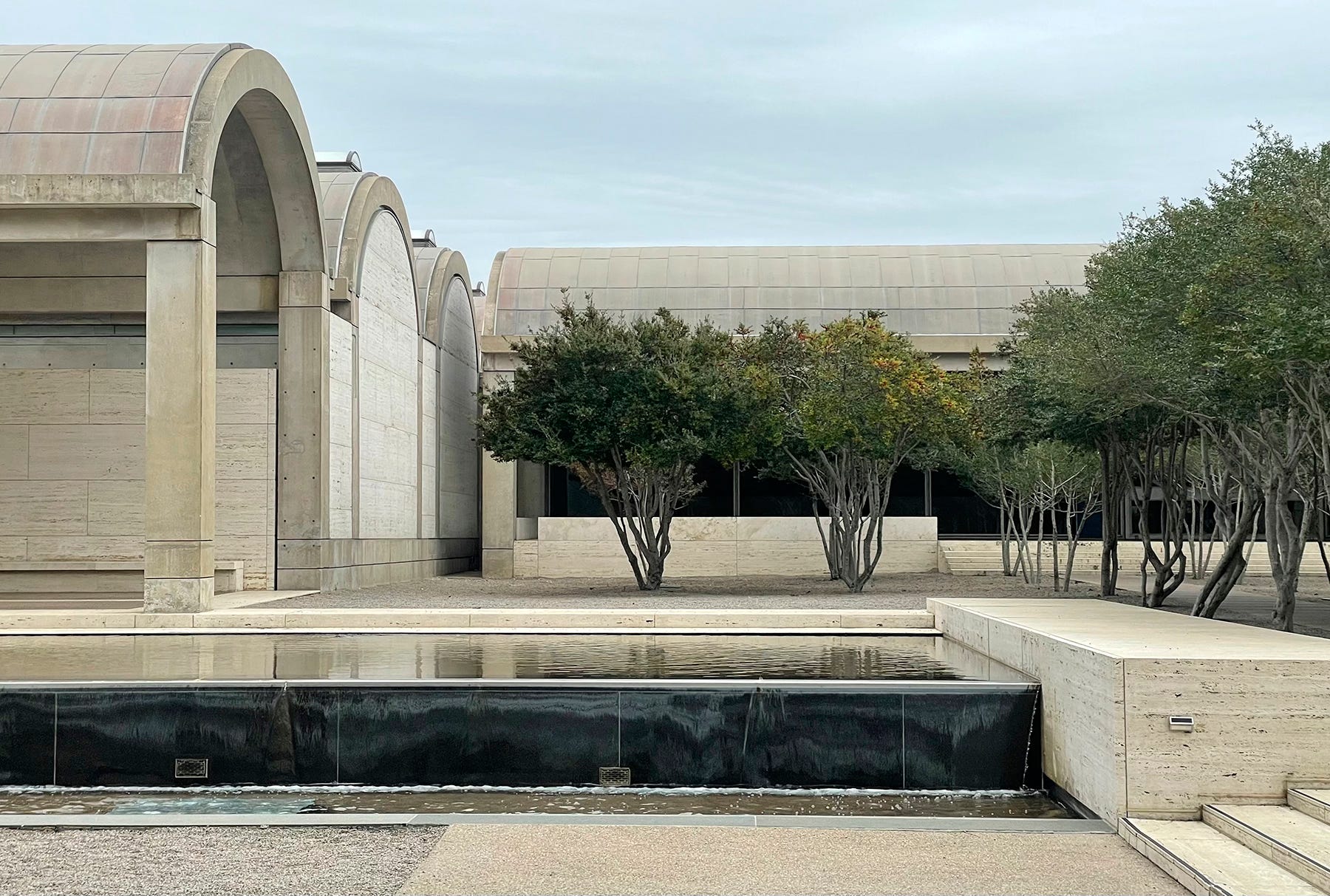
As I say, I am not religious, but insofar as my artistic life comes close to that sort of spiritual engagement, the museum is my church. Outside my own studio, it is where I go to seek this kind of non-verbal, revelatory experience which is the only kind of god I’ve ever been ready to believe in — i.e: something far larger than us, but in which we are nevertheless integral components. I don’t think the art is that thing; it’s just a doorway that can sometimes take us there. And if the museum is a kind of church for finding that experience, then Louis Kahn’s Kimbell Art Museum in Fort Worth, Texas is my Chartres Cathedral.
I felt that way about the Kimbell for years before ever having visited it. I think I saw my first photographs of the place as far back as college. Maybe they were in the big paving block of H.W. Janson’s History of Art which we lugged around as freshman. More likely they were shown me by an architect chum and former RISD classmate with whom I later shared a studio in Brooklyn and who worked hard to persuade me that the design and construction of the greatest buildings was on an artistic par with these epiphanic sorts of paintings that I found so moving. I guess he finally succeeded because I certainly feel that way about the Kimbell.
Despite that early fascination with the place, I never got over to visit it until January of 2024 when I had to deliver a painting from a museum show of my own work in Midland Texas to a collector friend in Fort Worth. Knowing I would be in town for a couple of days, I blocked out a morning to visit the museum, unaware at the time of what was currently on exhibit. I just wanted at last to see that great building and bathe in the light and space of its elegantly arched galleries. It was a hell of a surprise then when I walked though the doors to find a perfectly curated survey of some of the best paintings Pierre Bonnard ever made
If the Kimbell is my Chartres, then those paintings were the most luminous stained glass windows it could possibly have had on display for my visit. And how on earth to write about them? I’ve tried often, but Bonnard defies the gravity of prose. It’s a cheap shot to conclude that you have to see what he does to understand it, but if you don’t see it, it really can’t be described for you. Maybe the challenge then is to describe how to get to the place where you might be able to see it.
I certainly didn’t see it in the beginning. As a young guy, I was never much interested in or impressed by Bonnard. I thought his drawing unforgivably sloppy and his paint application sloppier still, which is somewhat ironic given that one of the early Modernist complaints about him was that his work was too pretty to be serious. One of my art history teachers in the PostModern era even dismissed him casually as a sentimental throwback to Impressionism; a lightweight in the shadow of the macho muscle men of Cubism and Abstraction. In my case, I was too oppositely hung up on a much earlier romance with the classically facile mark to get that he was looking past all of those things to something deeper.
The ice finally broke sometime in the mid 1990s when I happened on The Breakfast Room, a Bonnard interior that resides in the permanent collection at the Museum of Modern Art in New York. It’s a tall vertical canvas in which the golden wainscotting and purple curtains of a provincial interior frame an implausibly saturated, violet, green and blue landscape of trees through a window which takes up the center of the composition, but skewed ever so slightly to the right. At bottom, arrayed on a bright tablecloth bathed in morning sunlight, an assortment of luminous tea cups, pitchers and other breakfast crockery dance toward the lower left corner of the table while a figure — presumably his wife, Marthe — shyly peeks into the frame above.
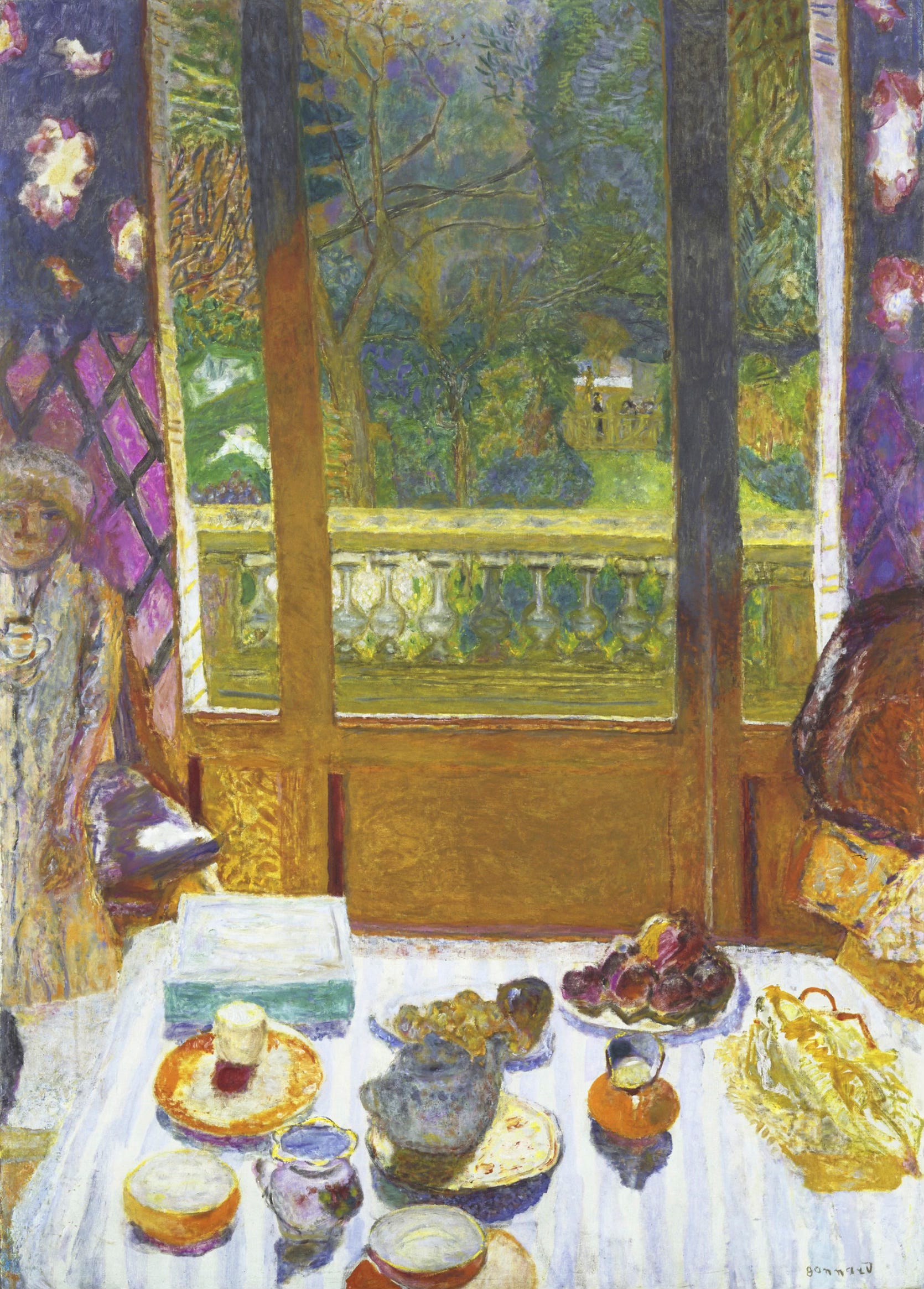
There is an interview from 2006 with the painter Rackstraw Downes in his Tribeca studio in which he talks about the “rhetoric” of certain conventional approaches to picture making. “I wondered” he asks himself — “could you paint a mountain without falling victim to the mountain rhetoric?” Meaning, one supposes, those pat expectations we unconsciously carry about within us of how a mountain, or any other familiar pictorial tableau, is supposed to look. There is no such rhetoric in Bonnard. He seems to calculate every mark, every placement of an object or figure and every color so as to challenge what we expect to see while suffusing the whole composition in a quietly insistent pulse of energy and chroma through which each of its riot of elements vibrates out to the viewer with light and life.
The first Bonnard Retrospective that I saw at MoMA in 1998 had been a life changer for me. It came long enough after that first transforming encounter with The Breakfast Room that by the time I went to see it I was finally ready to understand and appreciate what I was being shown. It was one of a handful of forks in the road that I’ve encountered in my creative life which took my own work in a new direction and also the point at which I began to see him as the great painter of the twentieth century. Nobody else could come close for me, though there are so many whom I also love.
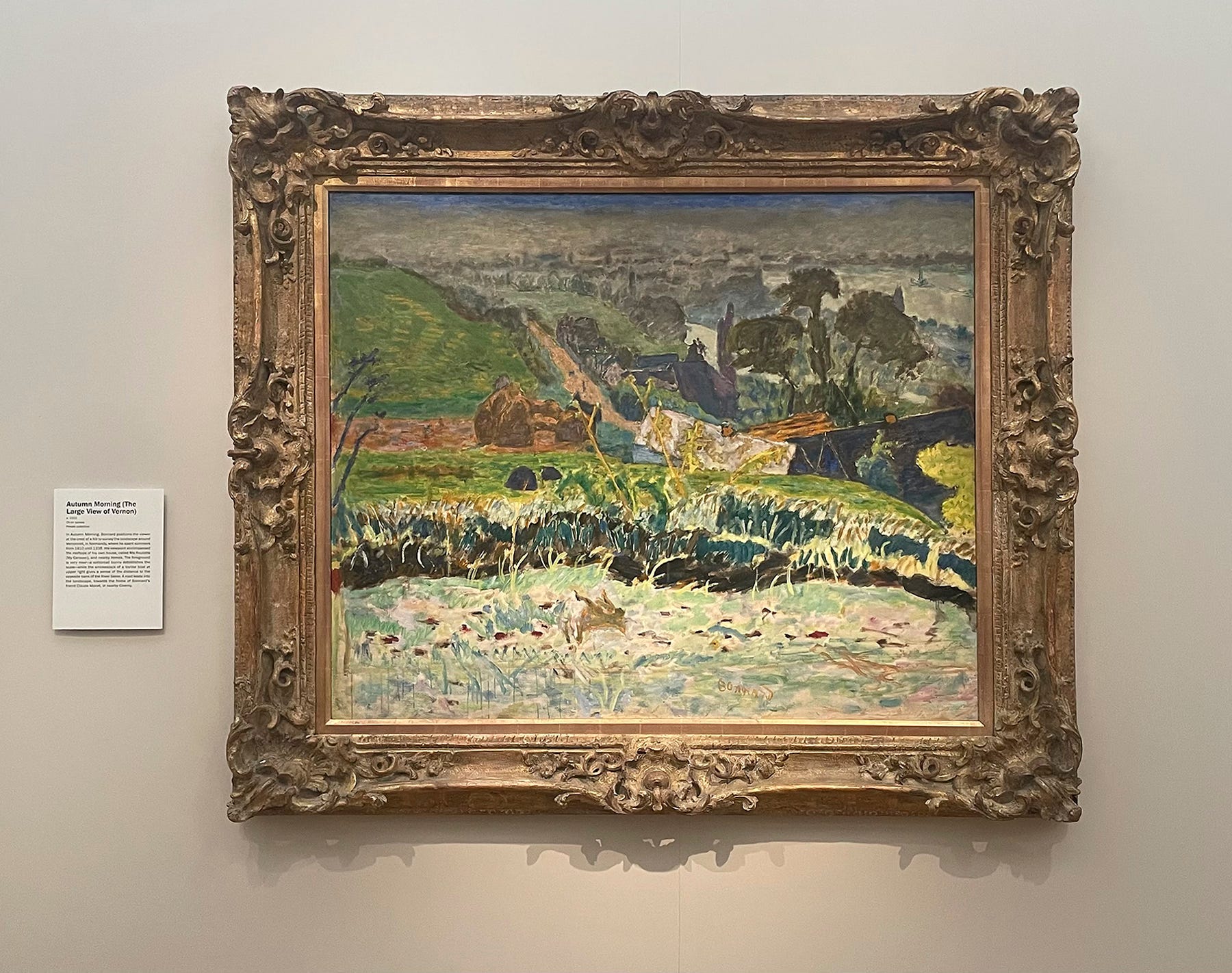
Seeing the smaller, more exquisite array of Bonnards at the Kimbell twenty-six years on from that much bigger retrospective extravaganza in New York has been one of the most nourishing and transporting experiences I have ever had as a painter, but also just as a human being. The works were so thoughtfully sequenced in that simultaneously venerating but also intimate architectural space. The whole character of the experience was antithetical to the now all-too-familiar commercial glut of the so called “blockbuster” museum exhibit. The space was quiet, well attended, but not overly crowded. The people there seemed to understand intuitively that the purpose of that work was not to be checked off a list as some duly recorded performance of cultural tourism before exiting through the gift shop with an I SAW BONNARD tee-shirt and a pair of designer readers tucked into a toney, rope-handled and logo-emblazoned shopping bag. Instead, they seemed to be moving slowly and quietly through the rooms, stopping here and there to allow the light emanating from every canvas on those walls to envelop and transform them, however fleetingly. We were all together being given the benefit of an instant and penetrating satori at every moment where a particular picture was able to reach out and make a direct and personal connection to just that right person who had stopped to stand before it.
I have no idea what real cultural value art has any longer for anybody else, and especially not in an age that is racing as fast as it can to forget what that value ever was in the first place. I do know though what it does for me, and it feels worthwhile to describe that feeling now as the purveyors of AI are gleefully promising to strip away every vestige of the fulfilling creative callings still available to us. Our human spirit and intelligence are alike made, elaborated and refined through engagement — the engagement of looking, of making, of reading, listening and conversing directly with every intelligently made or naturally complex emanation of life that we encounter. The proposition of developing, then implementing a technology expressly designed to take all of that away from us is to me an event reeking of the most staggering stupidity that I am able to imagine. If you are a person who actually believes that this tsunami of snake oil rolling towards us is a great thing, I highly recommend that you go to a museum where a real, physical Bonnard painting can be found. Go there on a weekday, early in the morning ahead of the crowds. Turn off your phone and stand in front of that thing for as long as it takes to remember what you are actually made of. Let it wash over and into you until you forget everything else. And then, if you really want to take it to another level, imagine what it would take for you to make something like that yourself. It may not change your life, but it sure did change mine.
Hi from Fogland Road, which I believe you know well. (Yes the wind still howls, and the potatoes still grow.) I thoroughly enjoyed reading (and rereading) this essay.
This stuck out to me:
“a quietly insistent pulse of energy and chroma through which each of its riot of elements vibrates out to the viewer with light and life..”
Well, first, congratulations for putting it so succinctly. That pulls together the best explanation i could come up with for painting (smears of colored grease on rags.) Your words struck me all the more because I have been thinking a lot about the vibration in painting of marks -here there/in out- that remind me of locating a wave/particle.
I’m glad you wrote about experiencing Bonnard. I can’t wait to see one again. -Peter
I wish I had gone all the way to Texas to see that show. I remember a big show at the Philips many years ago, but this looked far grander. Yes, Bonnard is very difficult. I had a book of his aphorisms once; taken from his notebooks. A quote: "It's all very well to paint yourself a dada (Fr. slang for hobbyhorse) but don't mistake it for a Pegasus". Another story about someone who complained about the way a patterned floor seemed to be pasted between the woman's legs: "Sometimes a mistake is the making of a picture". Another, "brush in one hand, rag in the other". Some of the so- called avant garde painters of the twenties dismissed Bonnard as a butterfly of impressionism. Well, nobody looks at those avant garde painters now. They look tired and predictable. Bonnard is always new. Always intensely inventive. Who else can paint the shadow of a fruit black and make it work? A personal story: I was visiting the graduate school at BU once and was speaking to James Weeks. He asked about my painting. I said I was very influenced by Bonnard. He paused thoughtfully and then said, "That can be either very good or very bad." Bonnard has swamped many, many painters.