
Time to Work
On the gestational potentials of the "Artist's Block"

I read somewhere recently about an elderly Zen monk who continued to do heavy physical labor at his monastery even as his body began to fail. His younger companions in the community tried to protect him from injury by keeping him away from such risky projects, but his simple answer was “No work, no life.”
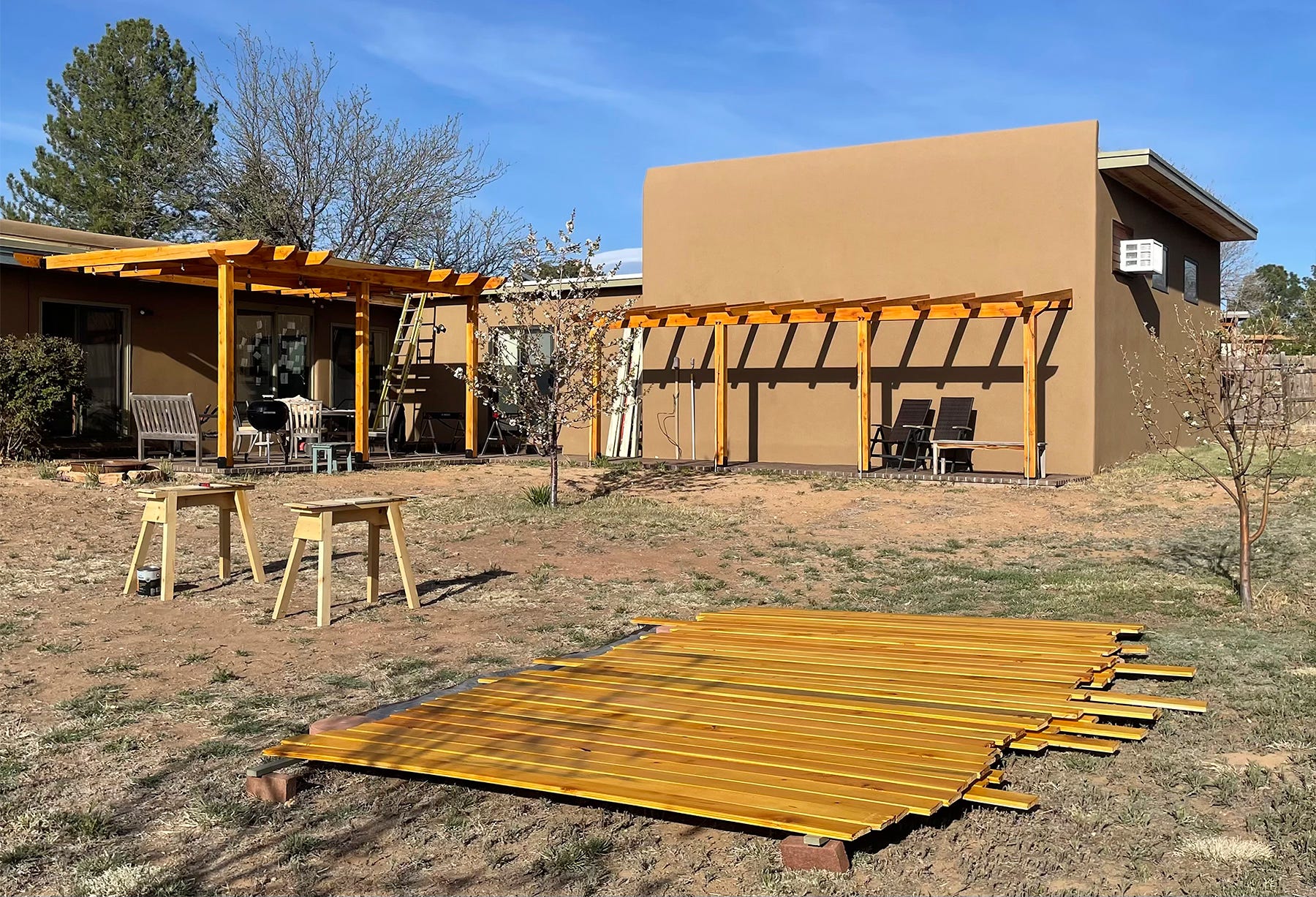
I seem to be at work on something all the time. Even on Sunday, the one day in the week when a complete break can sometimes occur, I often find a project in which to become embroiled. Yesterday, for instance, it was a morning of helping our youngest son to move the last of his things from our house to his new place, and then an afternoon spent out in the sun with my wife, staining some fifty-seven boards for sheathing the roof of a shaded portale I’ve been building along the back wall of my studio over the past year.
Like the monk, I can’t imagine not working. As for retirement, that idea is completely alien. As has been true for all the artisans, painters, sculptors, writers and musicians whom I have known right up to the ends of their lives, I hope at that moment when I too head out the door to have only just put down my tools.
But there are different kinds of labor and very different ways in which we do it. Creative people work to many different drummers beating many different rhythms. For those of us who aspire to artistry of some kind, those patterns are bound up in, and conditioned by, a range of expectations — both externally commercial and internally philosophical or even moralizing — against which our most satisfying creative breakthroughs often strain. Late in his life, Edward Hopper famously took a very long time to get around to making a painting. There is a passage in one of his biographies that describes an empty canvas on his easel which, his wife Jo informs a visitor, he had been looking at for a whole year. Dean Richardson, a painter I studied with in college, was given a Guggenheim grant early in his career and reportedly spent the whole year it had paid for “turning his dartboard inside out.” Willem DeKooning took two years to complete Woman Number 1.
On the other hand there are those who get up at a regular hour every day and beaver away in the studio, shutting out the world entirely, for a full eight to ten hours. I know one older painter who seems to put in strictly scheduled daily regimens like that and who often has several different paintings going, in several different workspaces in his compound, at the same time. Another younger painter friend frequently boasts of periods in which he has made “forty” or “fifty” new pieces.
I am lucky if I make ten paintings in a year. Sometimes I manage as many as twelve, sometimes less than five. Perversely (like Dean and Hopper) my actual productivity frequently wanes in direct inverse proportion to the amount of free studio time I have been able to bank. Throughout my twenties I worked more or less full time in a cabinet shop on the waterfront beside the Brooklyn Bridge, but somehow also got quite a bit of painting done, either in evening or weekend sojourns in my nearby studio, or in the week-long breaks I could sometimes pry away from my employers when enough cash had piled up to underwrite a longer session.
All through my post-college years in New York I chafed at my day job, grumbling my way through the tasks at hand and resenting them for stealing my cherished painting time. Every Fall I applied for grants that never came, dreaming always of that mythic fantasy of a year in the studio with no other distractions. At one point, a kindly aunt did give me enough cash to take a trip to England and then spend a few months back home painting what I’d seen there, but I was still working in the cabinet shop to keep the lights burning.
I finally decided late in that decade to engineer a grant of my own. After my first solo gallery show, and having also amassed a small cadre of patrons for whom I had done commissioned pieces, I proposed a compact to these folks in which they would fund a year of painting out west at the end of which I would bring back enough pieces to enable each of them to select from at least two examples as repayment for the advance.
It was a cheeky scheme, and some of those I petitioned declined to participate. But I did pull together enough of a group to make it just barely possible. So, at twenty-eight, I set off from New England in a Chevy van filled with art supplies (and the woodworking tools I was cautious enough to also pack) to paint the desert southwest. Arriving in Santa Fe and renting a tiny one-room casita, I quickly proceeded to do — nothing.
The year stretched out to two, then to two and a half. The money had run out within the first few months and I was soon back to carpentry and some other part time work in the studio of a book designer friend. I traveled, photographed, explored the strange desert and mountain landscapes of the American West, but I did not paint.
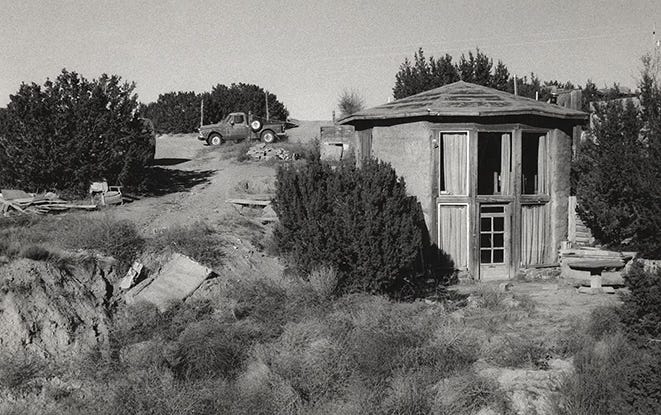
By the beginning of my second year in New Mexico, after multiple trips to the San Francisco Bay Area (where I met my future wife) I’d found a bigger house on the prairie twenty miles outside town where I could barter carpentry for rent from a pair of artist landlords. It was a bare little half-finished, two-story adobe shack; a Navajo-style round house, stuffed like a coffee can into the side of an arroyo. It had been built by a painter of presumably Irish extraction named John Hogan (the locals called it “Hogan’s Hogan.”) Heat came from a propane unit in a nicely finished bathroom wing and from a big horizontal oil-drum woodstove on the ground floor where I painted. The kitchen consisted of a sink, a hotplate and a rusty old 1960s fridge. A little metal table and a futon bed sat on a platform opposite the kitchen counter and under the open beams of an octagonal roof from which a variety of alarming arachnids sometimes tumbled into bed with me. I also shared the space with gigantic centipedes, mice, a Mexican long-eared bat and a cranky Russian Blue cat named Frank, who appeared one day from the arroyo and adopted me. I lived on beans, rice and morning excursions for coffee and pastries from a hippy bakery in town. Frank helped himself to the plentiful prairie fauna. One winter I burned much of my furniture just to keep the pipes from freezing. But I did finally begin to paint, and by the time my Californian girlfriend and I moved back to New England in a caravan of wagons and trailers, I’d landed a good gallery in Santa Fe, helped my landlord finish a new kitchen at the Hogan and was hauling enough paintings in the trailer to satisfy my long-suffering backers at home. The Mexican bat came to our going away party.
Forty years on, I still wrestle with the same old rhythms of work, contemplation, avoidance and distraction. This winter I managed again to carve out a chunk of time in which to paint. I didn’t buy myself that mythic and perennially yearned-after year in the studio, just a few months. I’ve done some ok things in that time: one painting that I actually like and a handful of monotypes that also feel pretty good. But now I’m onto a big canvas and although there is a multi-layered start on it, it has completely stalled. The metaphorical dartboard calls.
Day after day, week after week, I dawdle, avoid or simply ignore this big mustard-hued mess on my easel. I work on my website, do small odd jobs for print clients, visit with artist pals, cobble some carpentry for the family home and sell an occasional print or painting to keep the coffers full. But the act of painting itself has stopped. That old “Puritan Work Ethic” that my Yankee father (one of those dogged nine-to-five guys) lathered me with as a teen carps in his voice from one musty corner of my brain while another voice — my own I suppose — reassures me that this is just who and what I am and have always been. This is how I get the work done.
So if painting itself isn’t the whole of “the work”, what exactly is this part? I hesitate to make qualitative generalizations about the ways in which other artists ply their trade. There are many different paths to the goal and one way is not perforce better or more morally upright (as my dad seemed to believe) than another. What I do know, however, from my own patterns and experience is that it is much easier to get down to work on a project of skill than one of exploration. I am not stalled on this big canvas because I don’t know how to paint, but because I’m pretty good at it. It doesn’t follow though that my art is always good as a result of that skill because art — it turns out — is not about skill. Skill is certainly part of it, and maybe it’s the part we have to learn first. But the most important breakthroughs and revelations cannot be arrived at by the merely dogged application of expert labor, or that vaunted 10,000 hours which the writer Malcolm Gladwell and others posit as some sort of ironclad metric of mastery.
If the good stuff comes at all, it sometimes comes by arm-wrestling one’s own most dependably satisfying aesthetic habits, formulas and solutions down to the table and doing something instead that feels completely wrong in one way, but fully liberating in another.
I write a lot about how the market has corrupted this calling to make art in a spirit of discovery and risk. And I’m sorry, but dependably marketable artistic products — works that readily lend themselves to “branding” — are in every way antithetical to this dangerous place where actual art can sometimes find us. We don’t make it. What we make are the conditions in which it can occur. And these hours, months or even years of deliberation and even avoidance through which one’s conventions and habits get broken down, are one of the doorways through which it occasionally arrives.
Again, your words ring ever so familiar. The older I get and the deeper I get into this creative life I am learning that those "other" creative "distractions" actually fuel the whole. I am more and more happy to go dig up my garden or complete some long over due carpentry on my home. Sure, time painting is important, but so is the time just looking and thinking. When the paintings finally arrive they are usually worth the wait.
An interesting trip down memory lane as you sort through the early phases of discovering yourself as an artist, a creator not a copier. I love the Dean Richardson reference and your own experience with the metaphorical dartboard during the first year in New Mexico. I had friend, a poet, back in the Brooklyn days and she talked about her process in a way that combined the two approaches you outline: her "workday" began in her writing room at maybe 8:00 am and extended into the early afternoon, every weekday. In that time, much of her activity comprised drinking a lot of coffee, looking out of the window or wandering around the room mindlessly picking things up and putting them down. But, she said, she needed the discipline of the room and the designated time in it, to allow the creative voice to emerge when ready.